
Introduction: Siddhartha Gautama and the Spiritual Awakening of Ancient India
Around the sixth century BCE, in the verdant foothills of the Himalayas, a prince was born whose internal revolution would permanently alter world thought. Known at birth as Siddhartha Gautama (frequently studied across world traditions and Portuguese scholarship as Sidarta Gautama), he was destined by birthright to command armies, govern vast territories, and inherit an opulent aristocratic legacy. Yet his ultimate legacy was not forged in conquest or statecraft. Instead, he embarked on an extraordinary quest for existential liberation, transforming himself into the Buddha (the Awakened One, or Buda).
The chronicle of this spiritual breakthrough is not merely a central pillar in the History of Buddhism (História do Budismo); it represents a watershed epoch in the broader History of India (História da Índia) and a foundational chapter in the comparative History of Religions (História das Religiões). By rigorously questioning the dogmas of ritual animal sacrifice, rigid caste hierarchies, and metaphysical dogma, Gautama pioneered an empirical, psychological path toward transcending suffering.
To understand how Siddhartha Gautama became the Buddha, one must examine the socio-political crucible of the ancient Gangetic plains, the psychological shock that tore him away from royal sanctuary, his harrowing brush with mortality through self-mortification, and his crowning realization under the Bodhi Tree. This detailed exploration charts how a solitary seeker redefined human consciousness and ignited one of the greatest movements in world history.
The Historical and Cultural Landscape in the History of India
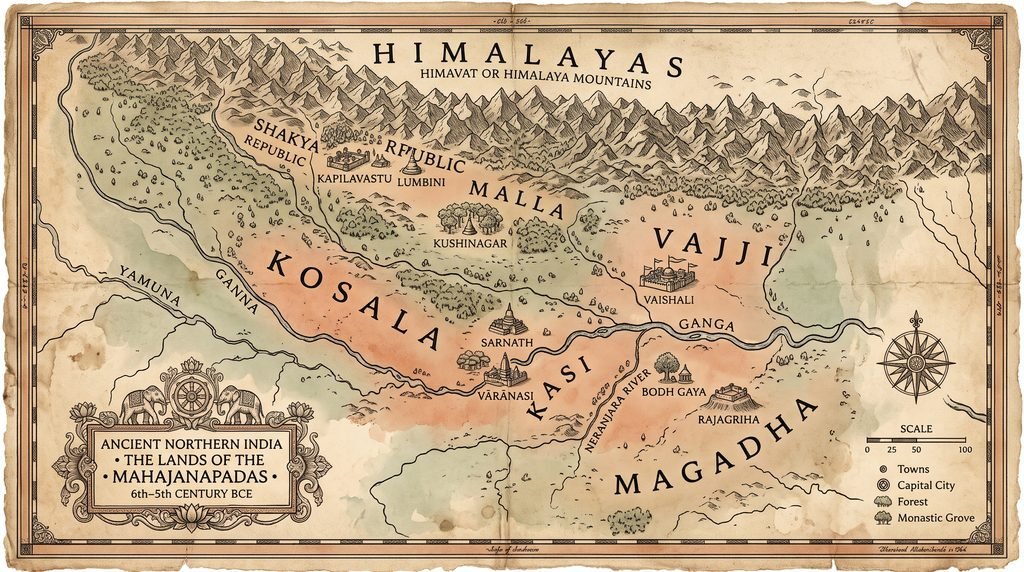
The life of Siddhartha Gautama unfolded against a tumultuous socio-economic backdrop known to modern historians as the Second Urbanization of northern India. Between 600 and 400 BCE, iron technology catalyzed agricultural surplus across the fertile Gangetic basin, driving rapid population growth, bustling commercial trade networks, and urban centers such as Rajagriha, Shravasti, and Vaishali.
Politically, this era witnessed intense friction between traditional tribal oligarchies—known as gana-sanghas—and ambitious, militaristic monarchies such as Magadha and Kosala. Gautama’s own people, the Shakya clan, governed an aristocratic republic centered in Kapilavastu. While later hagiographies idealized his father, Suddhodana, as a monarch of cosmic wealth, historical scholarship documented in the World History Encyclopedia confirms that Suddhodana was an elected noble leader (raja) presiding over a chieftain council.
This period of state centralization caused severe social alienation. The traditional Vedic religious system, dominated by Brahmin priests who mediated divine favor through costly animal sacrifices and liturgical incantations, felt increasingly detached from the existential anxieties of ordinary citizens, merchants, and thinkers.
       Vedic Orthodoxy
(Ritualism, Priestly Authority, Caste Hierarchy)
              │
              ▼ [Socio-Economic Disruption & Urbanization]
              │
      The Shramana Revolt
 (Forest Hermits, Jain Ascetics, Materialists, Skeptics)
              │
              ▼ [The Middle Way]
   The Rise of the Buddha
(Psychological Awakening, Moral Ethics, Empirical Meditation)
In response to this crisis, a counter-cultural wave erupted across northern India: the Shramana movement. These wandering mendicants abandoned householder life, shaved their heads, and sought direct experiential truth through extreme physical tapas (austerities), philosophical inquiry, and meditative seclusion. This dynamic intellectual environment makes the era indispensable to the History of India and an indispensable turning point in the global History of Religions.
The Royal Cage: The Early Life of Siddhartha Gautama in Kapilavastu
According to Buddhist canonical records preserved in the Pāli Canon and subsequent epics like Ashvaghosha’s Buddhacarita, Gautama was born in the sacred grove of Lumbini, a site recognized today by the UNESCO World Heritage Centre. Legend recounts that shortly after his birth, wise seers and the revered sage Asita inspected the newborn prince. Observing thirty-two auspicious physical marks on the infant, Asita prophesied that the child would take one of two paths: he would either become a Chakravartin (a universal monarch ruling the secular world with justice) or an enlightened sage who would uncover the cure for universal suffering.
Determined to preserve his political dynasty, Suddhodana designed a sanctuary of relentless hedonism to shield his son from worldly grief. Gautama was provided three distinct seasonal palaces—one for the monsoon, one for winter, and one for summer—replete with lotus pools, celestial music, fine silks, and exquisite cuisine. Every visible trace of decay, sorrow, disease, and death was systematically purged from his sight. At sixteen, he married the noblewoman Yashodhara, with whom he had a son named Rahula.
Yet, this engineered luxury generated an acute inner restlessness. In the Sukhamala Sutta, the Buddha looks back on his youth, observing that despite his peerless pampering, he could not banish the haunting realization that beauty, vitality, and wealth are transient illusions bound to collapse.
The Four Sights: A Defining Moment in the History of Religions
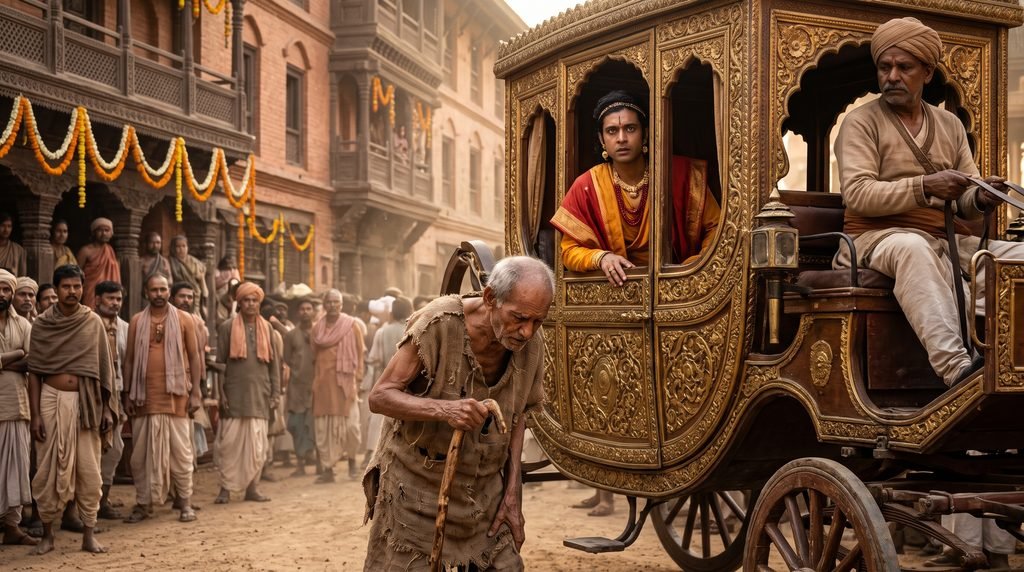
The protective wall built around Siddhartha Gautama proved unsustainable. As the prince matured, his yearning to inspect the world beyond palace gates forced his father to arrange carefully curated chariot excursions through the capital. Suddhodana commanded the streets cleared of any sight that might provoke melancholy or philosophical questioning.
Despite these precautions, the prince made four consecutive journeys accompanied by his loyal charioteer, Channa. These encounters—enshrined in religious history as the Four Sights (Catur-nimitta)—shattered Gautama’s psychological equilibrium:
- The Aged Man: On the first journey, Gautama saw an individual bent over with age, trembling, wrinkled, and leaning heavily upon a staff. Stunned, the prince asked Channa if this was a rare deformity. Channa answered that decrepitude is the inevitable fate of every living being fortunate enough to survive.
- The Sick Man: On the second excursion, he observed a man writhing in dirt, disfigured by disease, coughing in agony, and helpless without caregivers. Channa clarified that sickness strikes without warning, sparing neither beggars nor kings.
- The Corpse: On the third venture, Gautama encountered a silent procession carrying a shroud-draped figure toward the cremation pyre, followed by wailing relatives. Confronted with physical extinction, the prince understood that every relationship, body, and possession ends in cold ash.
- The Wandering Ascetic: On the final journey, Gautama saw a serene recluse wearing simple ochre robes, carrying an earthen bowl, with calm eyes reflecting profound inner peace. Channa explained that this was a shramana, one who had abandoned domestic vanity to seek truth, conquer greed, and master mortality.
The Four Sights represent a foundational milestone in the History of Religions. Rather than turning toward despair, Siddhartha Gautama viewed this existential crisis as an urgent call to action. If disease, decrepitude, and death were universal laws, then finding liberation from them was the only endeavor worthy of a human life.
The Great Renunciation: Breaking the Chains of Royal Privilege
Around the age of twenty-nine, the realization that his royal status offered zero protection against mortality drove Gautama toward a radical choice. The Ariyapariyesana Sutta (“The Discourse on the Noble Quest”) recounts this pivotal moment:
“Before my awakening, while I was still only an unawakened seeker, being myself subject to birth, aging, sickness, and death, I sought what was subject to birth, aging, sickness, and death. Then I thought: ‘Why do I, being subject to these things, seek what is subject to them? What if I were to seek the unborn, unaging, unailing, deathless, sorrowless, uncorrupted supreme security from bondage: Nibbana?'”
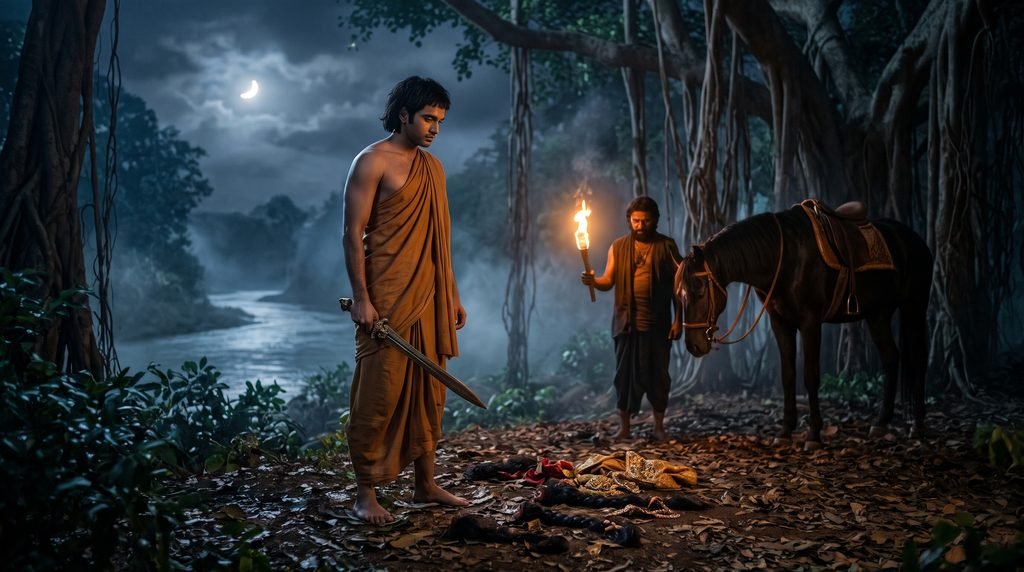
One night, after walking through banquet halls where court musicians and dancers lay asleep in disheveled exhaustion, Gautama stole a final, silent glance at his sleeping wife and newborn son. Knowing that sentimental attachment would bind him permanently to worldly governance, he slipped out of Kapilavastu accompanied only by Channa and his horse, Kanthaka.
       THE CROSSROADS OF DESTINY
   ┌────────────────────────────────┐
   │ Prince Siddhartha at Age 29    │
   └───────────────┬────────────────┘
                   │
         ┌─────────┴─────────┐
         ▼                   ▼
  [Secular Empire]    [Spiritual Renunciation]
  Universal Monarch   Homeless Shramana
  (Chakravartin)      (Search for Nibbana)
         │                   │
         ▼                   ▼
  Rule Kapilavastu    Awaken under Bodhi Tree
  Temporal Power      The Buddha / Eternal Dharma
Reaching the banks of the Anoma River, beyond the borders of his father’s domain, the prince performed the irreversible acts of renunciation: he cut his long hair with his sword, surrendered his regal jewels and embroidered robes to Channa, donned the coarse ochre rag of a beggar, and crossed into the forest wilderness on foot. This momentous event, known as the Great Renunciation (Mahabhinikkhamana), sent shockwaves through ancient Indian society and forever shifted the History of Buddhism.
The Forest of Mortification: Six Years of Ascetic Extremism
Entering the wandering life as a penniless seeker, Gautama immersed himself in the leading spiritual academies of his day. As noted in the comprehensive philosophical entry by the Stanford Encyclopedia of Philosophy, he first sought out master Alara Kalama, swiftly mastering an advanced state of meditative concentration known as the “Sphere of Nothingness.” Recognizing the prince’s genius, Kalama offered him equal leadership of his monastic assembly. Gautama declined, recognizing that deep meditative trance was temporary and failed to eradicate underlying subconscious defilements.
He next trained under Uddaka Ramaputta, quickly attaining an even subtler meditative state: the “Sphere of Neither-Perception-Nor-Non-Perception.” Again, Gautama realized that even this exalted mental state did not eliminate the delusion of a permanent self, nor did it extinguish the roots of future rebirth.
Leaving classical yoga teachers behind, Gautama resolved to conquer the mind through raw physical self-mortification (tapas). Joining five dedicated ascetics—Kondañña, Bhaddiya, Vappa, Mahanama, and Assaji—in the Uruvela forest near modern Gaya, he embarked on six brutal years of bodily torture:
- Breath Retention: He clenched his teeth and pressed his tongue against the palate, suspending his respiration until blistering internal pressures triggered agony in his skull.
- Radical Fasting: He systematically reduced his daily nourishment to a single drop of broth, a solitary grain of rice, or wild seeds.
- Physical Emaciation: The Maha-Saccaka Sutta records his physical decline: his spinal column stood out like a corded rope; his ribs overlapped like the rafter-poles of a dilapidated shed; his eye sockets sank deep like water gleaming at the bottom of a desert well; and when he rubbed his belly, he could feel his spine through his abdomen.
Yet, despite taking physical asceticism beyond human limits, enlightenment remained elusive. Gautama recognized that extreme starvation had exhausted his cognitive faculties, breeding mental torpor rather than transcendent clarity. Mortifying the flesh merely substituted the craving for worldly indulgence with the aversion to physical existence.
The Tuning of the Lute: Discovering the Middle Way
One afternoon, sitting near the Neranjara River, hovering near death, Gautama heard a passing boat carrying musicians. The master musician instructed his pupil on tuning the stringed vina (lute):
“If the string is strung too tightly, it will snap, and the instrument will remain silent. If the string is tuned too loosely, it will slacken, and no music will emerge. Only when tuned moderately does the lute produce celestial melody.”
This insight pierced Gautama’s awareness with mathematical precision. Sensual indulgence was a slack string—distracted, lazy, and bound to desire. Ascetic self-mortification was an overtightened string—violent, brittle, and bound to self-destructive agitation. True wisdom demanded balance: the Middle Way (Majjhima Patipada), steering clear of both extremes to cultivate quiet, stable, alert consciousness.
Shortly after this realization, a village maiden named Sujata arrived at the banyan tree where he sat. Believing the emaciated seeker to be an auspicious tree deity, she offered him a golden bowl filled with rich, honey-sweetened rice porridge boiled in pure cow’s milk (kheer).
Gautama accepted the food, drank clean river water, and bathed. When his five ascetic companions saw him eat wholesome food, they were horrified. Condemning him as a backslider who had abandoned the holy struggle for worldly comfort, they deserted him in disgust and departed for Sarnath. Gautama was left completely alone.

Under the Bodhi Tree: The Defeat of Mara and the Great Awakening
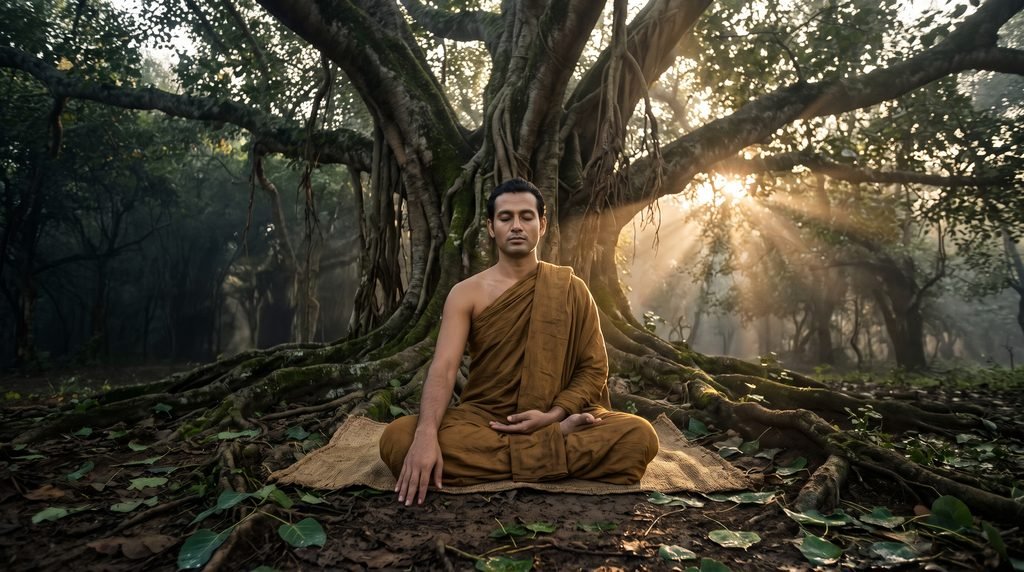
Replenished with physical strength, Siddhartha Gautama walked to the base of an enormous sacred fig tree (Ficus religiosa) in Bodh Gaya. Spreading a mat of kusha grass facing east, he took his seat in the full lotus posture. He declared an unwavering resolve:
“Let my skin, sinews, and bones dry up; let the flesh and blood of my body waste away! Until I attain supreme, peerless enlightenment, I shall not move an inch from this seat.”
As dusk settled, Gautama entered deep meditative absorption, ascending through the four progressive stages of concentration (jhana). According to Buddhist tradition, this spiritual resolution provoked Mara, the lord of illusion, desire, and death. Mara recognized that if Gautama conquered suffering, the wheel of karmic bondage would be broken.
                  THE NIGHT OF AWAKENING (BODH GAYA)
 ══════════════════════════════════════════════════════════════════════

  Dusk              FIRST WATCH           SECOND WATCH          THIRD WATCH (DAWN)
 ───────►          ─────────────►        ──────────────►       ──────────────────►
  Assault           Pubbenivasa-          Dibbacakkhu           Asavakkhaya
  of Mara           anussati              (Divine Eye)          (Destruction
  (Desire, Fear,   (Memory of past       (Law of Karma,        of Defilements)
   Ego, Doubt)      lives across          rebirth of all        Four Noble Truths,
                    eons)                 beings)               Dependent Origination
 ──────────────────────────────────────────────────────────────────────────────
                                                                ▼
                                                       SIDDHARTHA GAUTAMA
                                                          BECOMES THE
                                                          BUDHA (BUDA)
Mara launched a psychological assault:
- The Storm of Terror: Mara summoned shrieking winds, torrential downpours, earthquakes, and hordes of demonic warriors bearing flaming spears. Gautama perceived these horrors as mental fabrications and remained serene, watching the spears transform into fragrant lotus petals as they entered his aura of loving-kindness (metta).
- The Temptation of Seduction: Mara dispatched his alluring daughters—personifying Lust, Discontent, and Craving—to dance before the prince and ignite carnal attachment. Gautama remained unperturbed, perceiving the transience and empty nature of sensual forms.
- The Challenge of Sovereignty: Finally, Mara stepped forward, questioning Gautama’s right to claim liberation: “By whose authority do you claim this seat? I have performed countless acts of cosmic charity; who stands as witness for you?”
Gautama uttered no boast. Silently, he reached his right hand downward across his knee, touching the surface of the earth in the legendary Bhumisparsha Mudra (“Earth-Touching Gesture”). He summoned the planet itself: “The earth is my witness.” A deep tremor reverberated through the ground, affirming eons of selfless compassion, ethical purity, and spiritual merit. Mara and his legions dissolved into mist.
With mental hindrances extinguished, Gautama entered profound realization throughout the night:
- The First Watch (Dusk to Midnight): He attained the knowledge of recollecting his past lives (pubbenivasanussatiñana), perceiving the vast cycle of cyclic rebirth (samsara).
- The Second Watch (Midnight to 3:00 AM): He acquired the “Divine Eye” (dibbacakkhu), seeing how beings migrate through realms of existence governed by their own intentional actions (karma).
- The Third Watch (3:00 AM to Dawn): He pierced the definitive root of existence, formulating the doctrine of Dependent Origination (Paticcasamuppada) and realizing the Four Noble Truths.
As the morning star rose on the horizon, every trace of spiritual ignorance (avijja), craving (tanha), and aversion (dosa) evaporated. At thirty-five years of age, Siddhartha Gautama had extinguished cyclic rebirth. He was the Buddha—the Supreme Knower of the Universe.
Detailed artistic depictions and historical artifacts showcasing this transformation can be observed across international collections, such as The Metropolitan Museum of Art’s Life of the Buddha.
Setting the Wheel of Dhamma in Motion: The Dawn of the History of Buddhism
For seven weeks following his enlightenment, the Buddha remained near the Bodhi Tree, resting in the bliss of liberation (vimuttisukha). He hesitated briefly before teaching, recognizing that humanity was thoroughly intoxicated by desire and that this subtle, counter-intuitive truth would be difficult to grasp. Yet, moved by universal compassion, he journeyed over one hundred miles westward to the Deer Park in Isipatana (modern Sarnath, near Varanasi).
There, he encountered the five ascetics who had deserted him. Though they had vowed to shun their former master, the majesty and peace radiating from his presence compelled them to rise, prepare a seat, wash his feet, and listen.
In this first sermon, titled the Dhammacakkappavattana Sutta (“Setting in Motion the Wheel of the Dhamma”), the Buddha unveiled the foundational doctrine of Buddhism:
1. The Four Noble Truths (Cattari Ariyasaccani)
- Dukkha (The Truth of Suffering): Birth, aging, illness, death, separation from the loved, association with the unloved, and unsatisfied desire are inherently unsatisfactory.
- Samudaya (The Truth of the Cause of Suffering): The root of suffering is tanha—the insatiable craving for sensual pleasure, for becoming, and for non-existence.
- Nirodha (The Truth of the Cessation of Suffering): Suffering ends completely when craving is extinguished, leading to Nirvana—unconditioned peace.
- Magga (The Truth of the Path): The practical method leading to the end of suffering is the Noble Eightfold Path.
                    THE NOBLE EIGHTFOLD PATH
                             ┌───┐
                      ┌──────┤☸├──────┐
                      │      └───┘      │
       PANNĀ          │      SĪLA       │      SAMĀDHI
    (Wisdom /         │    (Ethical     │   (Concentration /
   Discernment)       │    Conduct)     │     Mental Power)
  ────────────────    │ ─────────────── │  ──────────────────
  1. Right View       │ 3. Right Speech │  6. Right Effort
  2. Right Intention  │ 4. Right Action │  7. Right Mindfulness
                      │ 5. Right        │  8. Right
                      │    Livelihood   │     Concentration
Upon hearing this discourse, the elder ascetic Kondañña attained the first stage of enlightenment, exclaiming: “Whatever is subject to origination is also subject to cessation.” The Sangha was born, marking the institutional genesis of the History of Buddhism.
For the subsequent forty-five years, the Buddha walked barefoot across northern India, teaching men and women of all social classes—monarchs, sweepers, courtesans, and murderers—without regard for caste or birth. At age eighty, in the forest grove of Kushinagar, he delivered his final words to his weeping disciples before entering Parinirvana:
“Behold, O monks, this is my final counsel to you: All conditioned phenomena are subject to decay. Strive diligently for your own liberation.”
The Enduring Legacy: How the Buddha Transformed the History of Religions and Global Philosophy
The transformation of Siddhartha Gautama into the Buddha remains one of the most consequential events in human intellectual history. As documented in scholarly retrospectives such as the Encyclopaedia Britannica’s Life of the Buddha, his teachings reshaped the civilizational fabric of the globe:
- The Democratization of Enlightenment: By rejecting the inherent superiority of Brahmin heritage and dismantling caste barriers within the Sangha, Buddhism challenged social stratification across ancient India. Spiritual attainment became a matter of conscious ethical action (karma) rather than hereditary birth.
- A Shift from Faith to Empirical Psychology: Unlike contemporary traditions reliant on external divine intervention or sacrificial propitiation, the Buddha positioned the human mind as both the battlefield and the sanctuary. His teaching was an invitation to “come and see” (ehipassiko), testing philosophical truths against personal experience.
- The Global Spread Across Asia: Within centuries, sponsored by visionary rulers like Emperor Ashoka in the third century BCE, Buddhism traversed the Silk Road into Central Asia, China, Korea, and Japan, while spreading south to Sri Lanka, Myanmar, and Thailand, cultivating distinct architectural, artistic, and philosophical legacies.
- Reshaping the History of Religions: Buddhism proved that a world religion could flourish based upon psychological insight, ethical non-harm (ahimsa), and radical compassion, inspiring modern psychology, mindfulness therapies, and existential philosophy worldwide.
Ultimately, the journey of Siddhartha Gautama was an unvarnished confrontation with the raw vulnerabilities of human existence. By confronting sickness, old age, and death, he unlocked a timeless path from confusion to clarity, proving that true freedom is attainable within the human mind.
Experience the Visual Epic: How Siddhartha Became the Buddha
Reading about the Great Awakening of Siddhartha Gautama reveals the philosophical brilliance of his path, but witnessing his dramatic confrontation with royalty, ascetic mortification, and the psychological siege of Mara brings this transformation alive.
Step directly onto the streets of ancient Kapilavastu, walk beside Channa as the Four Sights dismantle princely illusions, and feel the tension under the Bodhi Tree as darkness yields to eternal light.
Watch the full historical drama produced by Get Me History:
Watch the video, subscribe to the channel, and uncover the historical and spiritual legacy that continues to illuminate civilizations across the globe.

Leave a Reply