
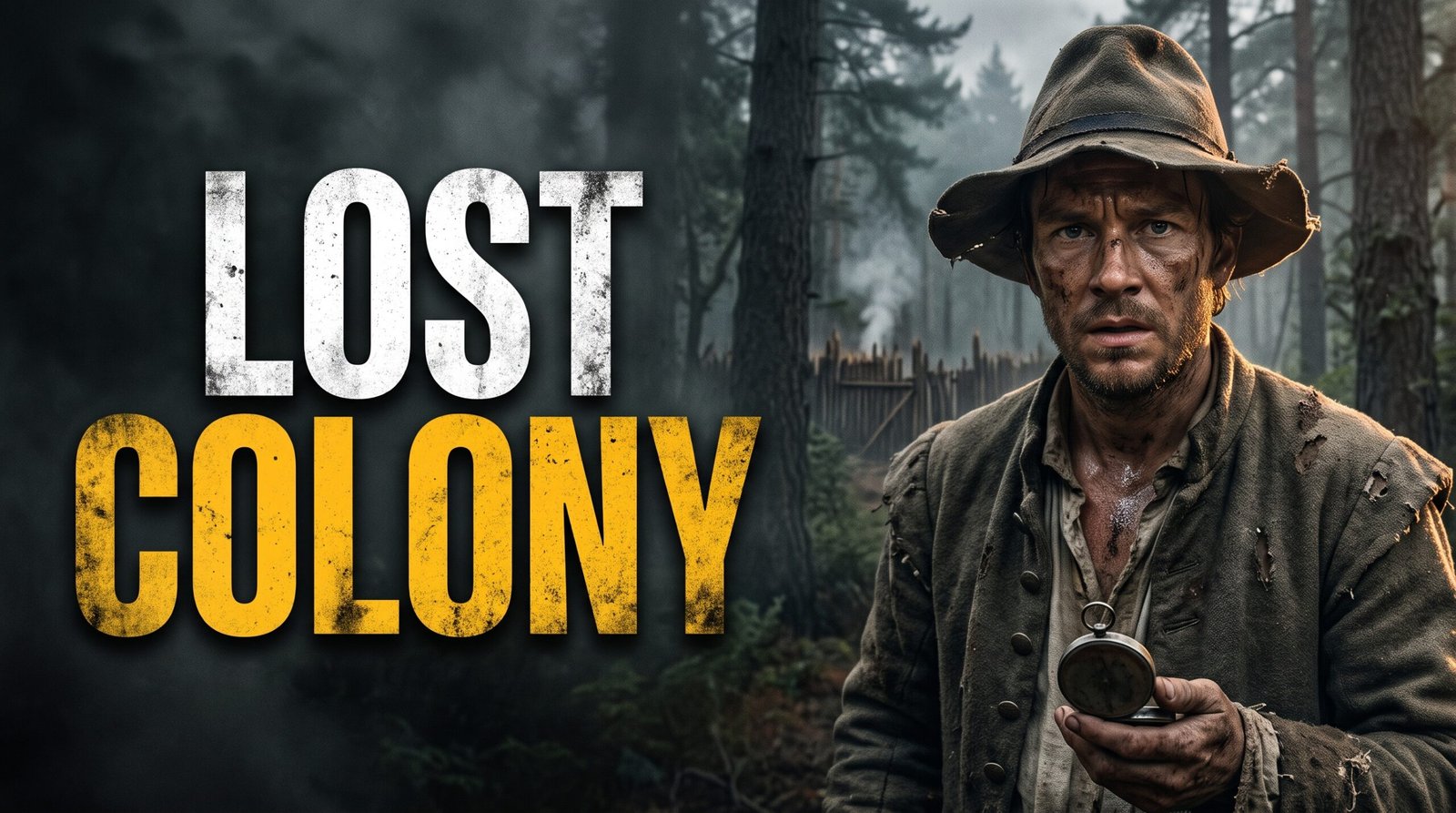
In May 1607, three English vessels navigated into the mouth of a wide river along the Atlantic coast of North America with a singular objective: extracting immediate profit. The Susan Constant, Godspeed, and Discovery carried just over a hundred men financed by private venture capitalists who envisioned discovering vast gold deposits rivaling those conquered by the Spanish Empire to the south. Instead of glittering lodes, these pioneers encountered dense tidal swamps, ruthless infectious disease, and politically sophisticated Indigenous nations. Thus began Jamestown, the first permanent English settlement on the North American continent and the indispensable foundational chapter for understanding United States history.
The trajectory of this fortified outpost in the heart of Virginia was defined by unremitting geopolitical friction, extreme biological hardship, and radical institutional transformation. Throughout the seventeenth century, the crucible of Jamestown established the economic, legal, and social frameworks that came to define American colonization. Far from a sanitized fable of frontier harmony, the true story of Jamestown reveals the foundational contradictions that shaped the Anglo-Atlantic world: the simultaneous birth of representative self-government and the institutionalization of racialized chattel slavery.
The Starting Point of American Colonization: Commercial Ambitions and the 1607 Voyage
The English endeavor in North America did not originate as a religious pilgrimage or an imperial royal expedition. It was an explicitly commercial corporate enterprise managed by a joint-stock company: the Virginia Company of London. In April 1606, King James I granted a royal charter authorizing private investors to sell shares, recruit laborers, prospect for precious minerals, and chart a navigable Northwest Passage to Asian markets, as documented in primary charters preserved by the Library of Congress.
                 THE INAUGURAL 1607 EXPEDITION
  =======================================================
  Fleet:            Susan Constant, Godspeed, and Discovery
  Naval commander:  Captain Christopher Newport
  Expedition size:  104 male settlers (soldiers and gentlemen)
  Departure:        December 1606 (London)
  Landfall:         April 26, 1607 (Cape Henry)
  Settlement date:  May 14, 1607 (James Fort)
  =======================================================
Ascending the waterway they christened the James River, the landing party under Captain Christopher Newport selected a marshy peninsula roughly forty miles inland from Chesapeake Bay. This choice reflected strict seventeenth-century European military doctrine. Settlers feared maritime raids from the Spanish Crown, which claimed the entire North American seaboard. The inland peninsula allowed deep-draft ships to anchor right beside the shore while giving sentries commanding fields of fire against hostile European warships.
Yet military tactics proved to be a public health catastrophe. The surrounding waters were tidal and brackish during hot summer months, trapping sewage and industrial waste around the perimeter. The stagnant wetlands served as breeding grounds for mosquitoes carrying malaria, while contaminated drinking water triggered rampant outbreaks of dysentery, typhoid fever, and salt poisoning.
The socioeconomic profile of the original 104 colonists intensified these vulnerabilities. More than half were registered as “gentlemen”—men of the English gentry unaccustomed to manual labor and untrained in carpentry, blacksmithing, well-digging, or commercial agriculture. The lack of seasoned farmers and skilled tradesmen paralyzed early work details, sparking bitter factional infighting within the governing council while food rations rapidly spoiled.
Survival in Jamestown: From John Smith’s Leadership to the Winter of Cannibalism
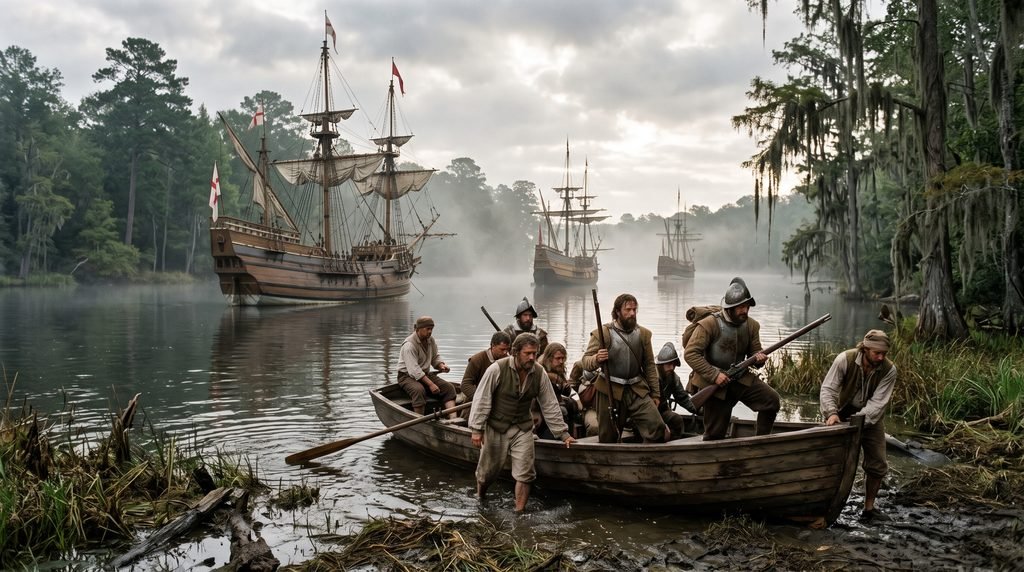
As hardtack and barley meal decayed under the stifling Virginia summer, mortality surged. By the close of 1607, barely thirty-eight men remained alive. Amid this collapse, Captain John Smith emerged as the dominant leader of the colony. A hardened soldier of fortune who had fought Ottoman armies in Eastern Europe, Smith understood frontier survival through the lens of absolute military discipline.
Assuming practical control of the settlement in the autumn of 1608, Smith enforced an uncompromising labor regime. He repaired the triangular palisade, expanded the storehouses, and instituted a mandate derived from Saint Paul: “He that will not work shall not eat.” Gentlemen were compelled to fell timber alongside laborers, while Smith spearheaded trade negotiations and expeditions across the Chesapeake to secure vital bushels of maize from regional tribes.
Smith’s departure in late 1609, prompted by severe burns from an accidental gunpowder explosion, triggered the colony’s darkest hour: the agonizing winter of 1609–1610, remembered as The Starving Time.
Trapped by an Indigenous trade blockade and abandoned by erratic transatlantic supply lines, approximately five hundred inhabitants found themselves besieged inside the fort. Contemporary accounts written by survivors, such as George Percy, detail how colonists exhausted their stored provisions, slaughtered horses and hogs, consumed domestic dogs and cats, and ultimately scavenged for rats, snakes, boot leather, and roots.
The catastrophe culminated in survival cannibalism. For centuries, historians questioned whether accounts of anthropophagy were sensationalist exaggerations. However, in 2013, forensic excavations by the Historic Jamestowne / Jamestown Rediscovery project unearthed the fractured skull and tibia of a fourteen-year-old English girl (nicknamed “Jane”). The skeletal remains showed distinct, post-mortem butcher marks, confirming beyond doubt that desperate survivors butchered deceased peers to avert starvation.
       MORTALITY RATE DURING "THE STARVING TIME" (1609-1610)
  ==============================================================
  Estimated population in October 1609:   ~500 settlers
  Surviving population in May 1610:       ~60 settlers
  Seven-month mortality rate:             ~88% loss of life
  ==============================================================
In May 1610, the skeletal remnant abandoned the ruins of Jamestown, boarded pinnaces, and drifted downriver toward the sea. Only an extraordinary twist of timing saved the enterprise: at the mouth of the river, they encountered the incoming relief fleet of the newly appointed governor, Thomas West, Lord De La Warr. Carrying seasoned soldiers, ample provisions, and sweeping martial powers, De La Warr intercepted the evacuees, ordered them back to the island, and implemented draconian martial law (Lawes Divine, Morall and Martiall), salvaging the Virginia venture from total extinction.
Indigenous Relations and Tobacco: The Economic Turning Point in United States History
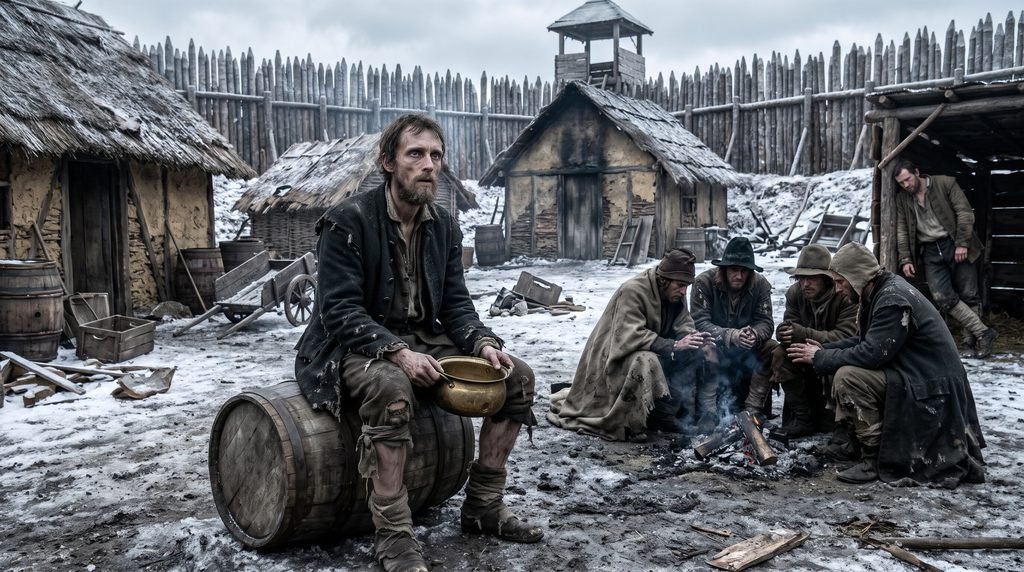
The survival of the English foothold hinged on its complex relationship with the Powhatan Confederacy. The land seized by the newcomers was Tsenacommacah, an alliance of over thirty Algonquin-speaking tribes commanded by the paramount chief (Mamanatowick) Wahunsenacawh, known to the English as Chief Powhatan. The Indigenous nations maintained structured systems of seasonal rotation, forest clearance, and companion planting of maize, beans, and squash.
Initially, Wahunsenacawh sought to integrate the English newcomers as subordinate trade vassals who could supply iron axes, copper sheets, and glass beads in exchange for game and grain. Yet constant English trespasses on native planting grounds and the cultural arrogance of colonial officers quickly escalated trade into armed conflict.
            CLASH OF CIVILIZATIONAL MODELS (1607-1620)
  ------------------------------------------------------------------
  POWHATAN CONFEDERACY             | ENGLISH VIRGINIA COMPANY
  - Leader: Wahunsenacawh           | - Leader: Military Governors
  - Society: 30 integrated tribes   | - Society: Joint-stock enterprise
  - Land tenure: Usufruct/communal  | - Land tenure: Private enclosure
  - Objective: Regional balance     | - Objective: Resource extraction
  ------------------------------------------------------------------
The historical figure of Amonute (popularly known as Pocahontas), Wahunsenacawh’s daughter, stood at the center of this cultural frontier. Her famous intervention to shield Captain John Smith from execution is evaluated by modern ethnohistorians as a choreographed tribal adoption ceremony rather than a romantic interlude.
In 1613, English forces captured Pocahontas to coerce concessions from her father. During her captivity at Henricus, she converted to Christianity, took the baptismal name Rebecca, and in 1614 married the English planter John Rolfe. This union forged an eight-year interlude of diplomatic stability known as the Peace of Pocahontas.
While this marriage secured peace on the frontier, John Rolfe was also pioneering the enterprise that rescued Virginia financially. Early exports of sassafras and timber could not cover corporate debt, and native tobacco (Nicotiana rustica) tasted unpalatably harsh to European consumers.
Beginning around 1612, Rolfe acquired seeds of Nicotiana tabacum from the Spanish Caribbean and planted them in Virginia’s nutrient-rich soil. The experiment was a commercial sensation. The cured leaf produced a mild, aromatic smoke that sparked unprecedented demand across English and continental markets.
Virginia found its green gold. Forests were felled to expand plantations; even the open streets of Jamestown were planted with crops. In 1617, export shipments exceeded twenty thousand pounds; within a decade, exports reached millions of pounds annually. This land-intensive monoculture demanded continuous westward expansion onto Powhatan hunting territories, triggering violent frontier wars that permanently scarred the development of United States history.
The Decisive Year of 1619 in United States History and American Colonization
By 1619, Jamestown had evolved from a struggling military outpost into an expanding agrarian commonwealth. That single year produced two defining moments that established the structural framework of American colonization and American civilization at large: the birth of parliamentary legislative representation and the introduction of African slavery.
The Emergence of Representative Government
On July 30, 1619, guided by reforms enacted by Sir Edwin Sandys—a reform-minded leader of the Virginia Company determined to encourage immigration through property rights and legal stability—the first legislative assembly in the Western Hemisphere convened within the timber-frame choir of the Jamestown church: the General Assembly, whose elected body became the historic House of Burgesses.
These burgesses were elected delegates representing plantations, towns, and settlements along the James River. This body enacted ordinances establishing tobacco quality benchmarks, localized taxation, and legal regulations. This modest gathering instituted the constitutional tradition of local legislative self-determination and civilian taxation consent that would, 157 years later, provide the legal and philosophical rationale for the American Revolution.
                    THE 1619 FOUNDATIONAL PARADOX
  ==================================================================
  JULY 1619:                         AUGUST 1619:
  Convene the House of Burgesses      Arrival of the privateer White Lion
  inside Jamestown's wooden church.   at Point Comfort / James River.
  ---------------------------------   -----------------------------
  - First elected legislature.        - Arrival of "20 and odd"
  - Constitutional precedent of       enslaved Angolan captives.
    representative government.        - Foundation for racialized,
  - Seeds of the 1776 Revolution.     permanent plantation slavery.
  ==================================================================
  POLITICAL FREEDOM AND CHATTEL BONDAGE CODIFIED ON THE SAME SOIL
The Arrival of the White Lion and the Roots of Slavery
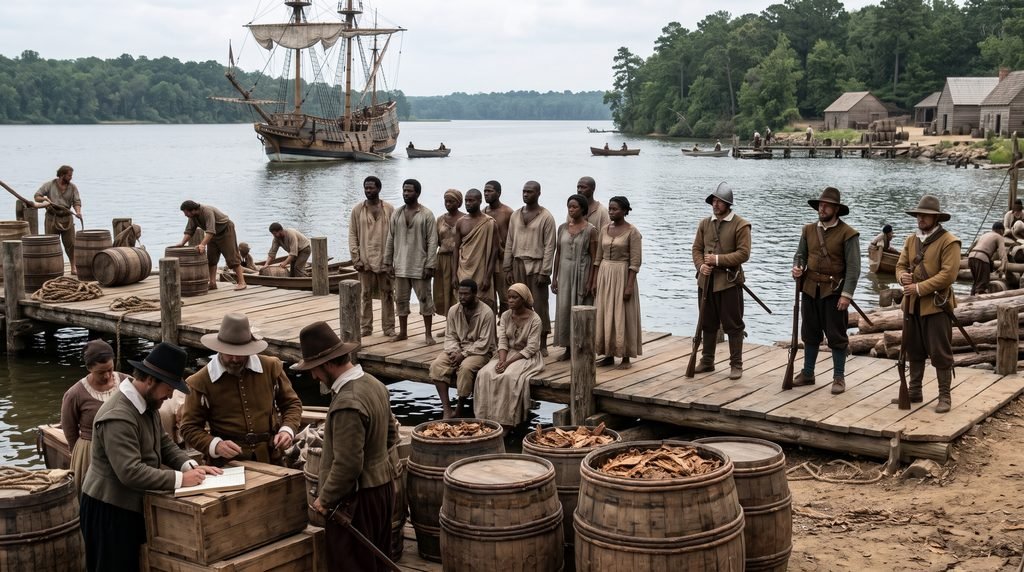
Barely a month after that legislative session adjourned, in late August 1619, the English privateer White Lion dropped anchor at Point Comfort. The ship carried “twenty and odd” captive Africans seized from the Portuguese slave ship São João Bautista, which had departed the port of Luanda in the Kingdom of Ndongo (modern-day Angola).
Running low on maritime provisions, the privateer traded these men and women to colonial authorities, including merchant Abraham Piersey and Governor Sir George Yeardley, in exchange for food and ship maintenance. Archival records preserved by the National Park Service highlight John Rolfe’s written testimony detailing the transaction.
In the initial decades following 1619, the legal parameters of African labor remained fluid. Many were treated under terms similar to European indentured servants, and select individuals—most notably Anthony Johnson—eventually acquired freedom, land, and servants of their own.
However, as tobacco farming surged and indentured labor from England dwindled, Virginia’s planter class deliberately codified racial bondage into hereditary, permanent chattel slavery. Between 1660 and the Virginia Slave Codes of 1705, the assembly decreed that an infant’s legal status derived exclusively from the mother (partus sequitur ventrem), that Christian baptism did not confer emancipation, and that non-white laborers were lifetime legal property. This tragic precedent rooted in 1619 became the deepest institutional fracture in all of United States history.
Wars, Rebellions, and the Decline of Jamestown in American Colonization
The aggressive spread of tobacco farms inevitably destroyed relations with the Powhatan Confederacy. Following the deaths of Wahunsenacawh and Pocahontas, supreme authority passed to the warlord Opchanacanough, who resolved to drive the colonizers into the ocean.
On the morning of March 22, 1622, Powhatan warriors entered scattered plantations unarmed under the guise of trading food. At an appointed signal, they seized tools and weapons, launching a synchronized strike across the colony. The offensive claimed the lives of 347 English settlers—nearly a third of Virginia’s European population in a single day.
Jamestown survived because a Christianized Algonquin youth named Chanco warned his employer the night before, allowing the fort garrison to seal its gates and repel the attack.
The English counter-campaign was devastating. Retaliatory expeditions implemented total war: burning native cornfields prior to harvest, dismantling villages, and poisoning drink casks during staged peace conferences. The human and military costs bankrupted the Virginia Company of London. In 1624, after royal investigators documented mismanagement and catastrophic death tolls during this chapter of American colonization, King James I revoked the company’s charter and established Virginia as a Crown Colony.
                 CHRONOLOGY OF THE ANGLO-POWHATAN WARS
  ========================================================================
  1609–1614: First Anglo-Powhatan War (ended by the marriage of Rolfe)
  1622–1632: Second War (sparked by Opchanacanough's coordinated offensive)
  1644–1646: Third War (ended with the capture of aged Opchanacanough)
  1646:       Treaty establishing formal reservation boundaries and tribute
  ========================================================================
In 1676, Jamestown became the epicenter of the largest colonial insurrection prior to the War of Independence: Bacon’s Rebellion. Frustrated by economic depression, high taxes, and Governor Sir William Berkeley’s refusal to authorize aggressive land seizures from neighboring tribes, Nathaniel Bacon organized an armed coalition of poor freeholders, European indentured servants, and enslaved Africans.
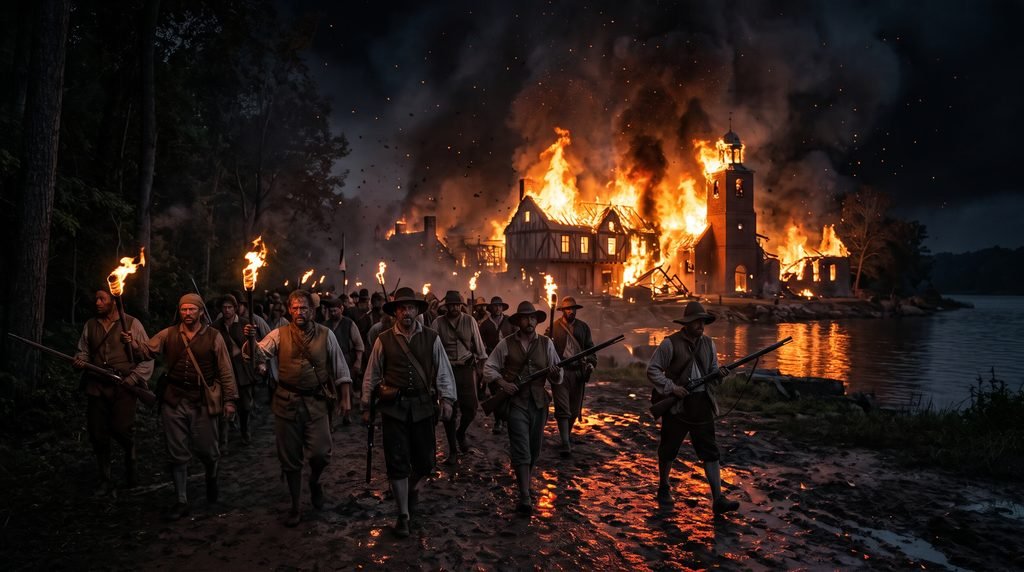
Bacon’s forces marched on the capital, forced the royal governor to flee across Chesapeake Bay, and put Jamestown to the torch on September 19, 1676. Although the rebellion dissolved following Bacon’s death from dysentery, the multiracial uprising alarmed Virginia’s plantation oligarchy. To prevent future class alliances between impoverished Europeans and Africans, the colonial assembly enacted stringent racial divisions that stripped non-white populations of customary legal protections.
The urban fate of the original settlement was sealed. After another catastrophic fire gutted the statehouse in 1698, the colonial capital was moved inland to Middle Plantation (renamed Williamsburg) in 1699. Jamestown was largely abandoned to tenant farming, its earthworks and seventeenth-century brick structures slowly buried beneath silt and river tides.
The Enduring Legacy of Jamestown in United States History
For more than two centuries, mainstream historical memory centered the landing of the Mayflower at Plymouth Rock (1620) as the foundational narrative of the nation. The story of devout Pilgrims pursuing religious liberty and celebrating Thanksgiving offered a morally comforting national myth, far removed from the commercial exploitation, cannibalism, and racial slavery of Virginia.
Yet any rigorous exploration of the continental past demonstrates that modern America’s economic and political roots run directly through the James River. Jamestown was an unforgiving operational testbed. The plantation economy born of its tobacco boom, the violent displacement of Indigenous populations, and the adoption of racialized labor formed the economic model that dominated the American South until the Civil War of 1861.
Simultaneously, the debates inside the House of Burgesses proved that sprawling overseas colonies required local representative bodies to function, establishing the institutional traditions that produced George Washington, Thomas Jefferson, and James Madison—all native Virginians whose estates drew wealth from the economic path laid in 1607.
The recovery of this heritage accelerated in 1994, when archaeologist William Kelso and the Jamestown Rediscovery team proved that the original 1607 triangular fort had not eroded into the river. Decades of excavations have unearthed the original postholes, defensive ditches, armor pieces, musket balls, personal belongings, and burial grounds of the men and women who shaped this brutal frontier.
To examine Jamestown is to confront the unvarnished origin of modern America. On this small peninsula, democratic self-governance and hereditary bondage were inaugurated side by side. The triumphs, tragedies, and foundational contradictions forged in its muddy soil continue to shape the social, legal, and racial fabric of the nation today.

Leave a Reply