

In the turbulent late 16th century, Japan was engulfed in the flames of the Sengoku Jidai—the Warring States period. Warlords clashed across the archipelago for ultimate supremacy, while European caravels began docking at coastal ports, bringing matchlock firearms, crucifixes, and curious gazes toward an empire hitherto secluded from the Western world. It was amidst this profound political and cultural upheaval that an extraordinary figure emerged: Yasuke, the legendary African warrior whose life shattered contemporary geographic boundaries and carved an enduring legacy into the History of Japan.
His journey transcends mere biographical curiosity. Crossing oceans amid the expanding machinery of European mercantile dominance, he defied rigid conventions of caste and culture. Far more than a passive witness to a brutal epoch, Yasuke became one of the most compelling figures in the History of the Samurai, proving that honor, martial prowess, and unwavering loyalty could flourish at the innermost court of the great unifier, Oda Nobunaga. Uncovering his story opens an often-overlooked chapter concerning Black People in Japan and reveals how the earliest global ripples of African Colonization connected distant continents during the early modern era.
Mercantile Expansion and the Roots of African Colonization
To grasp how a man born in Africa came to draw a katana through the streets of Kyoto, one must examine the maritime corridors linking the Atlantic to the Sea of Japan. The 16th century saw Portuguese naval hegemony flourish under the Padroado Real system. Portuguese navigators navigated the Cape of Good Hope, establishing strategic trading outposts along the East African coast, the Indian subcontinent, and Macau.
This commercial network thrived on the trade of spices, silk, and human cargo. The early stages of what would later mature into systemic African Colonization turned coastal harbors like Sofala and Mozambique Island into compulsory transit hubs. Countless Africans were uprooted and integrated into colonial fleets, serving as sailors, naval gunners, laborers, interpreters, and mercenary guards.
According to research documented in the Encyclopædia Britannica, the most widely accepted scholarly theory posits that Yasuke belonged to the Makua people of modern-day Mozambique. However, substantial historiographical arguments also suggest he may have hailed from South Sudan (among the Dinka) or Ethiopia (the historic Habesha people), renowned for their imposing physical stature and martial service aboard Indian Ocean merchant vessels.
Whatever his precise homeland, the young African was recruited or purchased into the entourage of the Society of Jesus. He became the personal bodyguard and valet to Alessandro Valignano, the influential Italian Jesuit appointed Visitor of Missions in the East Indies. Valignano needed physically commanding escorts to protect the mission’s valuable shipments along hazardous Asian overland and river routes. Without foreseeing the destiny awaiting him, the man the world would come to know as Yasuke sailed toward the Japanese archipelago.
The Meeting of Two Worlds: Black People in Japan During the 16th Century
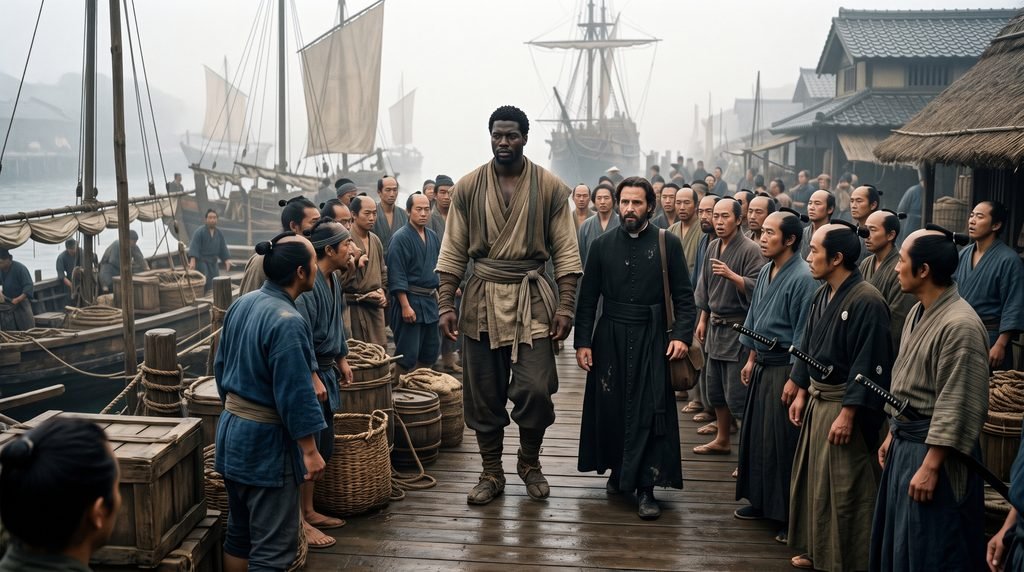
When Valignano’s delegation docked at the port of Kuchinotsu in Kyushu in 1579, it caused an immediate sensation. The Japanese referred to Portuguese and Spanish merchants as Nanban (“Southern Barbarians”), owing to their unconventional garments, prominent noses, and arrivals from the southern seas. Yet, the sight of Black men aboard these vessels stirred an even deeper fascination.
Traditional accounts long depicted feudal Japan as entirely closed to ethnic diversity. However, archival evidence demonstrates that the presence of Black People in Japan began alongside the earliest Portuguese traders in the 1540s. Africans worked in harbor docks, operated naval cannons, and walked the open markets of Hirado and Nagasaki. To local peasants and aristocrats, however, individuals with skin as dark as charcoal and towering statures seemed almost otherworldly.
In contemporary Buddhist iconography, wrathful guardian deities such as the temple guardians (Niō) and manifestations of Fudō Myōō were frequently portrayed with dark, pitch-black skin and fierce martial resolve. Rather than eliciting the racial prejudices later codified by the transatlantic slave trade in the West, the appearance of Black People in Japan inspired an awe-struck blend of mystical reverence, keen curiosity, and visual wonder.
Yasuke stood out even among his peers. He stood roughly 6 shaku and 2 sun tall (approximately 1.88 m or 6 feet 2 inches), at a time when the average adult Japanese male stood around 1.57 m (5 feet 2 inches). His presence commanded respect and astonishment wherever the Jesuit caravan passed.
The Turmoil in Kyoto and the Fascination of Oda Nobunaga
In March 1581, Alessandro Valignano traveled to the imperial capital of Kyoto for an official audience with the realm’s most formidable leader: Oda Nobunaga. The audacious head of the Oda clan was in the midst of unifying the country under the banner of Tenka Fubu (“All the Realm Under One Sword”). A pragmatic revolutionary, Nobunaga embraced Western innovations, fielded mass ranks of arquebusiers, and showed little patience for traditions that hindered his military campaigns.
News that a “towering black man” had arrived in the capital spread like wildfire. Immense crowds swarmed the Jesuit residence in Kyoto hoping to catch a glimpse of the newcomer. Jesuit chronicler Luís Fróis recorded that the streets became impassable: onlookers climbed rooftops, jostled violently, and broke down the wooden gates of the compound. Several people were crushed or injured in the frenzy to see him.
The commotion was so overwhelming that Nobunaga, staying nearby at the Honnō-ji temple, ordered the foreigner brought before him at once. Their historic first encounter was recorded in the Shinchō Kōki (The Chronicle of Lord Nobunaga), authored by the loyal retainer and scribe Ōta Gyūichi, and examined thoroughly by the World History Encyclopedia.
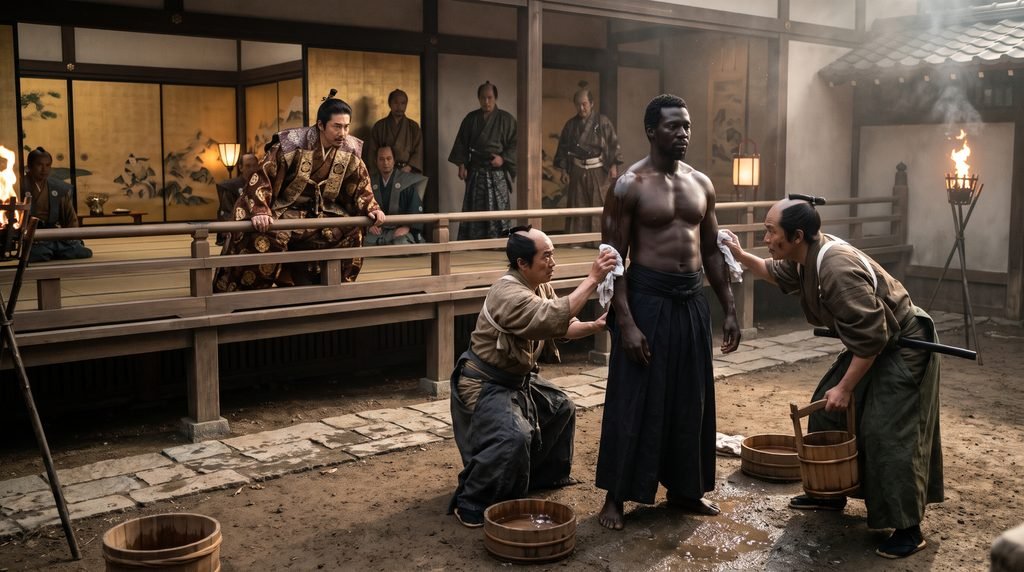
At first, Nobunaga suspected deceit. He assumed the Jesuits had dyed the man’s skin with black ink or charcoal as an elaborate trick. Driven by intense curiosity, Nobunaga ordered Yasuke stripped to the waist and scrubbed thoroughly in front of his court with warm water and sponges.
When the water ran clear and the man’s deep, lustrous complexion remained unchanged, Nobunaga was captivated. The warlord admired not only his appearance but also his extraordinary strength, which contemporary chroniclers described as rivaling that of ten men. Moreover, Yasuke spoke conversational Japanese with poise and intelligence, displaying quiet composure in the presence of the feared hegemon.
The History of the Samurai and Yasuke’s Rise as a Warrior
Enchanted by the newcomer’s bearing and vitality, Oda Nobunaga arranged with Valignano for Yasuke to enter his personal service. It was at this moment that the lord bestowed upon him the formal Japanese name by which history remembers him: Yasuke (彌介). From that day forward, his life became inextricably woven into the History of Japan.
Modern debates often question whether Yasuke truly attained samurai status or served merely as a bodyguard. However, viewed through the lens of scholars specializing in the History of the Samurai, the answer is unequivocal. During the late Sengoku period, the warrior class had not yet hardened into the rigid bureaucratic caste established under the Tokugawa shogunate. The rank of bushi was defined by direct martial allegiance to a lord, the right to carry arms, and the provision of a formal stipend.
Nobunaga welcomed Yasuke into his most trusted inner circle:
- Bestowal of Weapons and Residence: Nobunaga personally presented Yasuke with a ceremonial sword (katana) and private quarters near the clan’s seats of power;
- Official Stipend: He was granted a regular stipend (fuchi), legally recognizing him as a salaried retainer of the warlord;
- The Role of Koshō: Yasuke was appointed as a page-at-arms and elite bodyguard. Retainers in this position accompanied the lord at private feasts, slept near his chambers to foil nighttime assassinations, and rode at his side on campaign.
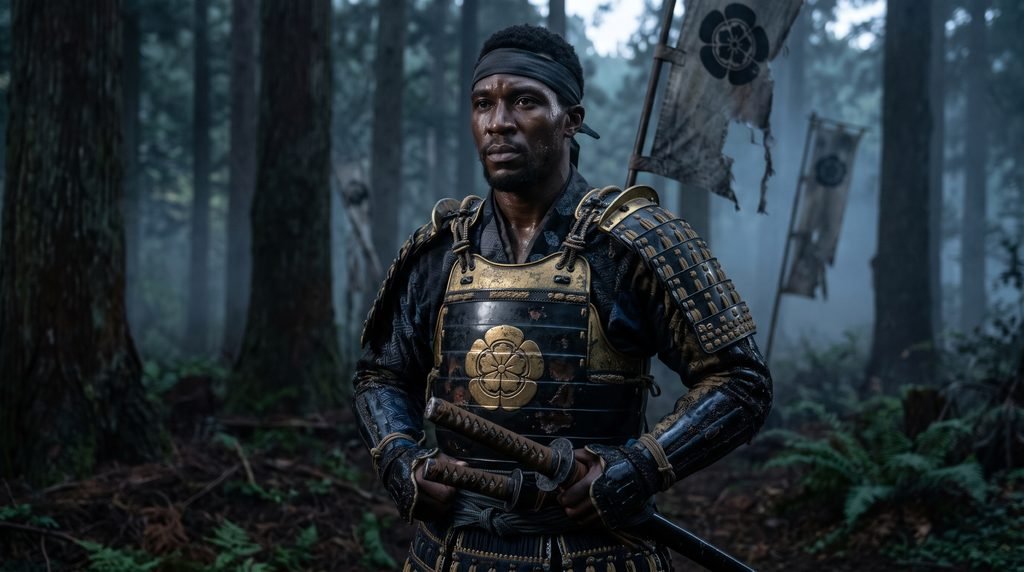
While the presence of Black People in Japan remained mostly confined to southern trading outposts, Yasuke traversed the capital carrying forged steel blades in his sash, clad in fine garments and lacquered armor. Respected by Nobunaga’s generals and feared by his enemies, Yasuke earned his lord’s deep affection. Jesuit dispatches even noted that Nobunaga enjoyed conversing with him so much that he openly contemplated granting him an estate, a castle, and formal troop command in the future.
The Faithful Guardian and the Connections with African Colonization
The contrast between Yasuke’s fate in the Far East and contemporary developments across the Atlantic and Indian oceans is striking. In the Atlantic, the early machinery of African Colonization was beginning to strip millions of their humanity in colonial plantations and silver mines. The African continent was increasingly subjected to imperialist exploitation, which denied its people dignity, nobility, or military leadership.
Yet in feudal Japan, a man swept up in the global currents of that same expansion found recognition and honor within the warrior code. Far from colonial subjugation, Yasuke was respected by the Japanese military elite for his courage, discipline, and loyalty.
His journey demonstrates that early modern cross-cultural encounters were not purely one-sided. The presence of Black People in Japan challenges the assumption that non-Europeans played only passive roles in global exploration. Yasuke mastered the courtly etiquette of the warrior elite, understood battlefield tactics, and marched alongside Nobunaga during the triumphant campaign against the Takeda clan in Kai Province, where period chronicles confirm his prominent role in the victory procession.
Blood in Flames: The Honnō-ji Incident
Yasuke’s ascent was destined to culminate in one of the most tragic turning points in the History of Japan. By June 1582, Oda Nobunaga stood on the verge of unifying the fractured realm. Confident in his control, the lord traveled west accompanied by only thirty personal retainers and bodyguards—including Yasuke—pausing to rest at the Honnō-ji temple in Kyoto.
In the predawn darkness of June 21, 1582, General Akechi Mitsuhide, one of Nobunaga’s most trusted commanders, executed a treacherous revolt. Instead of marching west to reinforce ongoing campaigns against the Mōri clan, Mitsuhide diverted thirteen thousand troops back toward the capital, uttering the fateful words: “The enemy is at Honnō-ji!”
Awakened by war cries and flaming arrows tearing through paper-and-wood walls, Yasuke drew his weapons and fought desperately alongside Lord Nobunaga. As the main hall was consumed by fire, Nobunaga retreated into an inner room and committed seppuku, taking his own life to avoid capture.
Yet Yasuke’s duty in the History of the Samurai was not over. Breaking through Mitsuhide’s siege lines amidst smoke and ash, the African warrior sprinted through the streets to the nearby fortress of Nijō Castle, where Nobunaga’s eldest son and heir, Oda Nobutada, was stationed.
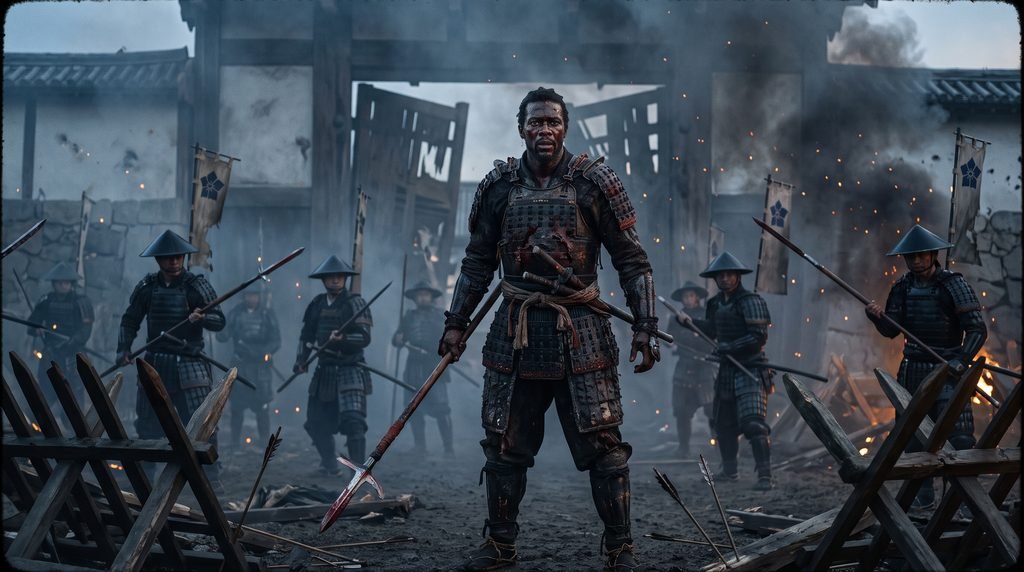
Yasuke joined Nobutada’s remaining loyalists and mounted a furious defense within the castle corridors. Jesuit reports confirm that Yasuke fought valiantly with spear and sword against waves of mutineers. Overwhelmed by superior numbers and cut off from reinforcement, Nobutada also committed ritual suicide. Exhausted, wounded, and standing alone amidst the fallen stronghold, Yasuke finally lowered his blade and was taken alive by Mitsuhide’s commanders.
The Judgment of Akechi Mitsuhide and the Enigma of His Disappearance
Brought in chains before the usurper Akechi Mitsuhide, Yasuke’s life hung by a thread. Any Japanese samurai captured under similar conditions would have been beheaded immediately or forced to commit seppuku. Yet Mitsuhide rendered a verdict that remains one of the most intriguing moments in the History of Japan.
According to contemporary Jesuit accounts, Mitsuhide dismissed him with cold disdain:
“This man is a beast, not a Japanese; he knows nothing of our customs or loyalty and does not belong to our lineage. Do not kill him. Hand him over to the church of the Nanban fathers.”
Historians debate Mitsuhide’s reasoning. Some interpret the remark as overt xenophobia, deeming a foreigner unworthy of the honorable death accorded to samurai. Others view it as cold diplomatic calculation: recognizing that Yasuke arrived under the aegis of the Jesuits, sparing him avoided immediate conflict with European traders and missionaries during a precarious grab for power.
Escorted alive to the Jesuit mission in Kyoto (Nanbanji), Yasuke was received with profound relief by the priests, who tended to his combat wounds. Yet once the mission doors closed behind him, Yasuke disappeared entirely from recorded history.
No surviving accounts document whether he returned to Africa, sailed with the Jesuits to India or Macau, or lived out his days peacefully in a coastal village in Kyushu. What remained was the silence of the archives—and the birth of an enduring legend.
The Eternal Legacy of Yasuke in the History of the Samurai and Global Culture
Bureaucratic silence never erased the memory of the African warrior. In recent decades, historians worldwide, such as Thomas Lockley and Geoffrey Girard, have revisited forgotten manuscripts to reconstruct his extraordinary biography. Yasuke demonstrated that the History of the Samurai was not defined solely by bloodline, but forged in combat, personal honor, and individual resilience.
His life also fundamentally reshaped historical understanding regarding Black People in Japan. Rather than being a mere historical footnote, Yasuke showed that Africans stood at the very center of pivotal events in feudal Asia, even as the global tragedy of African Colonization unfolded across other continents.
Today, Yasuke is a celebrated global cultural icon: starring in animated series, inspiring major film projects, appearing in landmark video game franchises, and captivating audiences across literature and art. His life endures as the unforgettable testament of a warrior who crossed oceans to become one of the most remarkable figures in the History of Japan.
Want to Discover Every Detail of This Epic Saga in Motion?
Yasuke’s story is just one of many extraordinary chapters where honor and valor defied the boundaries of time. To experience the full visual reconstruction of his epic voyage, examine the period armor, and witness the fateful stand at Honnō-ji, watch our comprehensive documentary on YouTube:

Leave a Reply